CONFIRMED / August 27, 2026
Nodusfall World: Facts vs. Fan Theory
What Nodusfall’s multi-mythology world is confirmed to contain, what the reveal suggests, and which details remain fan theory for lore hunters.
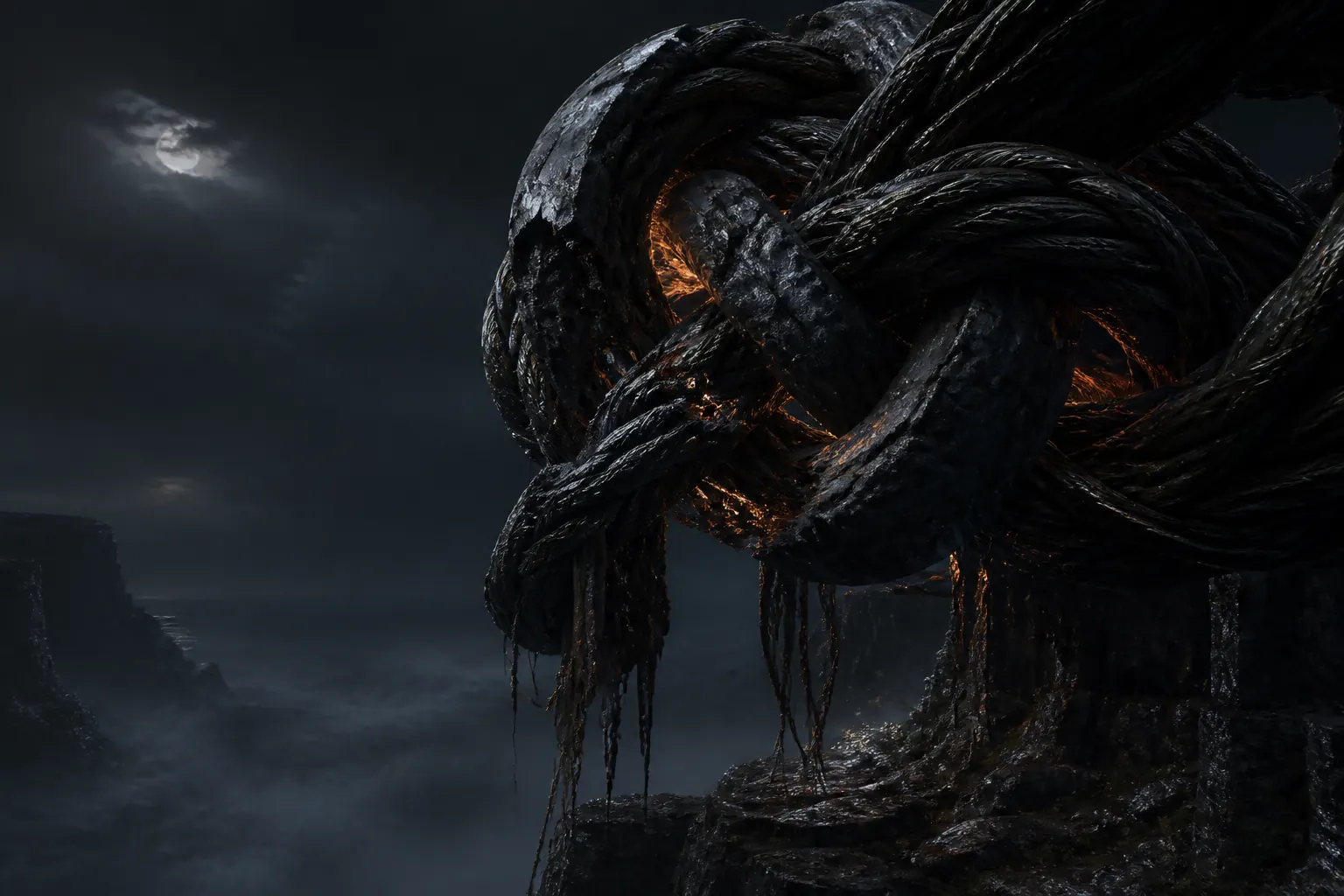
The confirmed world premise
HoYoverse describes Nodusfall as a self-contained fantasy world inspired by diverse mythological traditions. Its landscapes, civilizations, and divine order follow their own internal logic. The official text specifically frames the continent as a place where Eastern legendary beasts and Western dragons can exist inside one original setting.
That is more precise than saying the game is a direct retelling of several real-world mythologies. The confirmed promise is synthesis: familiar mythic ingredients, reorganized into a new world with its own cultures, ecology, and history.
What the transcribed breakdown adds
The Chinese video analysis reads several trailer images through a Chinese mythological lens, including possible references to the Classic of Mountains and Seas, a nine-tailed fox, Qiongqi, and a Chinese dragon. It also compares other images with Northern European dragon traditions and the Gordian Knot story.
These readings help explain why the reveal feels intentionally cross-cultural. They should remain labelled as visual interpretation: the trailer does not yet give each creature a canon name, origin, or boss role.
The best working theory
The strongest current interpretation is that Nodusfall uses a fictional continent as a meeting point for multiple mythic traditions, rather than dividing the game into one mythology per region. The official wording about distinct ecosystems, cultures, and histories leaves room for both approaches.
Until region names and lore entries arrive, this guide will separate direct evidence from motif tracking. That makes the theory useful without turning a trailer frame into invented canon.
What the record supports.
A quick audit trail for the claims in this article. Confidence labels keep confirmed facts separate from footage observations, third-party reports, and theory.
| Claim | Evidence | Confidence | Source |
|---|---|---|---|
| The world draws from diverse mythological traditions. | HoYoverse describes a self-contained fantasy world inspired by mythologies around the globe. | CONFIRMED | Official announcement |
| The game combines Eastern beasts and Western dragons. | The official overview gives both as examples of legendary creatures in the setting. | CONFIRMED | Official announcement |
| Specific trailer creatures are Qiongqi, a nine-tailed fox, or Fafnir. | Those names come from community and video analysis of visual motifs, not confirmed creature pages. | THEORY | Bilibili breakdown |
| Each region will have its own ecology and history. | The official text says new regions with distinct ecosystems, cultures, and histories will unfold as the journey progresses. | CONFIRMED | Official announcement |
Watch the signal in context.
Timestamps link directly to the source. Bilibili checkpoints come from a local speech-to-text pass of the Chinese-language analysis; YouTube entries are source-context links where captions were unavailable.
The analysis begins reading the reveal’s central knot image as a worldbuilding signal.
OPEN SOURCE Eastern myth motifsThe breakdown connects several visual motifs to Chinese mythological traditions; identifications remain interpretive.
OPEN SOURCE Mythic creatures in combatThe creature analysis gives way to a discussion of how mythic enemies may shape co-op encounters.
OPEN SOURCEFrequently asked questions.
What mythology is Nodusfall based on?
Nodusfall uses multiple mythological traditions inside an original fantasy world. It is not currently described as a direct retelling of one mythology.
Are the Chinese mythology references confirmed?
The official reveal confirms Eastern mythological inspiration, but individual readings such as Qiongqi or a nine-tailed fox remain community interpretations until named by HoYoverse.
Does Nodusfall have separate mythology regions?
Distinct regions, ecosystems, cultures, and histories are confirmed. The final regional structure and mythology boundaries are not yet public.
This article is an original editorial summary. Video material was transcribed or reviewed for research, then rewritten in English. It does not reproduce a full transcript.